
The life of Gram Parsons was marked by planting country music seeds in fertile ground that would eventually grow into a deeper appreciation for the genre well beyond its conventional borders.
Gram Parsons owns one of the most complex legacies in country music. Talk to some, and they’ll convince you he’s the undisputed godfather of country rock and alt-country who is significantly if not singularly responsible for conveying the coolness of country music to California and the rest of the world outside of country. It’s not uncommon to see his name mentioned as a candidate for the Country Music Hall of Fame due to this legacy.
Speak to others, and they’ll tell you Gram was a rich kid interloper who fittingly died of overdose at the age of 26—country music’s first hipster, if you will. Gram is revered for convincing The Byrds to record their landmark country album Sweetheart of the Rodeo (1968). But the band was famously booed when they made their debut on the Grand Ole Opry. In many respects, both of these Gram Parson legacies are true.
As wild, influential, and controversial as Gram’s short life and career were—which included mentoring Emmylou Harris, turning the Rolling Stones into country fans, and helping to front the Flying Burrito Brothers—Gram’s death was equally wild. After injecting morphine in Room 1 of the Joshua Tree Inn in California, Gram Parsons then returned to Room 8 where he would overdose on the combination of morphine and alcohol on September 19th, 1973. But this is just where the story of Gram Parsons’ death begins.
Gram Parsons critics love to point out how he came from affluence, but that tells an incomplete story. Just like Gram, both of his parents were raging alcoholics. Gram’s father committed suicide when he was growing up. His mother died due to complications from alcoholism on the day he graduated high school in Florida in 1965. His mother, Avis Snively Connor, did come from the wealthy Snively family that had large holdings in Winter Haven, Florida and Waycross, Georgia. When Gram’s mother married Bob Parsons, Gram took his stepfather’s name.
After Gram Parsons’ death, the body was supposed to be loaded up in a Western Airlines jet and transported to New Orleans for burial by his stepfather and family. However, Gram’s manager Phil Kaufman had other plans. While laying to rest another critically-important California country contributor in Clarence White, Gram had intimated to Kaufman that he didn’t want to be interred in the ground. He wanted to be cremated, and his ashes spread in Joshua Tree.
So in a semi-drunken expedition, Phil Kaufman and a friend borrowed a hearse, talked their way onto the tarmac at the airport and to the hangar where Gram’s body was being kept, and even convinced the individual at Western Airlines to release the body to them under the false notion they were transporting Gram to another airplane. There was even a police officer at the hanger who helped them load the casket into the hearse. They were so nervous, as they were driving out of the hangar, they ran into a wall.
Eventually Phil Kaufman made it out to Joshua Tree, wheeled Gram Parsons in his casket out into the desert, drenched the body with five gallons of gasoline, and lit him on fire, leaving him there to burn. Some nearby campers saw the smoke and alerted authorities. Meanwhile Kaufman and the hearse broke down, were involved in a fender bender getting back to Los Angeles, and eventually Kaufman got caught and charged with Grand Theft.
In Joshua Tree, you can find a guitar-shaped memorial to Gram at the Joshua Tree Inn. Room 8 is reserved for those who want to stay where Gram passed into the great beyond. Though many visit Cap Rock in Joshua Tree as the place where Gram was “cremated” and there is a makeshift memorial there, it was actually about a 1/4 mile away where the incident occurred. The National Forrest Service does not officially recognize the incident, perhaps not wanting others to try something similar. The story of the aftermath of Gram’s death was made into a movie called Grand Theft Parsons (2003) starring Johnny Knoxville.
But the actual remains of Gram Parsons (or what was left of them) eventually made their way to New Orleans where he was laid permanently to rest at the Garden of Memories Cemetery in Metairie. Why New Orleans when Gram was from Florida and Georgia, and was most famous in California? Gram’s stepfather Bob Parsons was hoping to exploit Louisiana’s strange Napoleonic Code at the time. If Bob Parsons could be recognized as Gram’s closest male relative, and establish Gram as a resident of Louisiana, he could inherit Gram’s estate. That is why Gram Parsons ended up in New Orleans, away from family, music friends, and other celebrity graves.
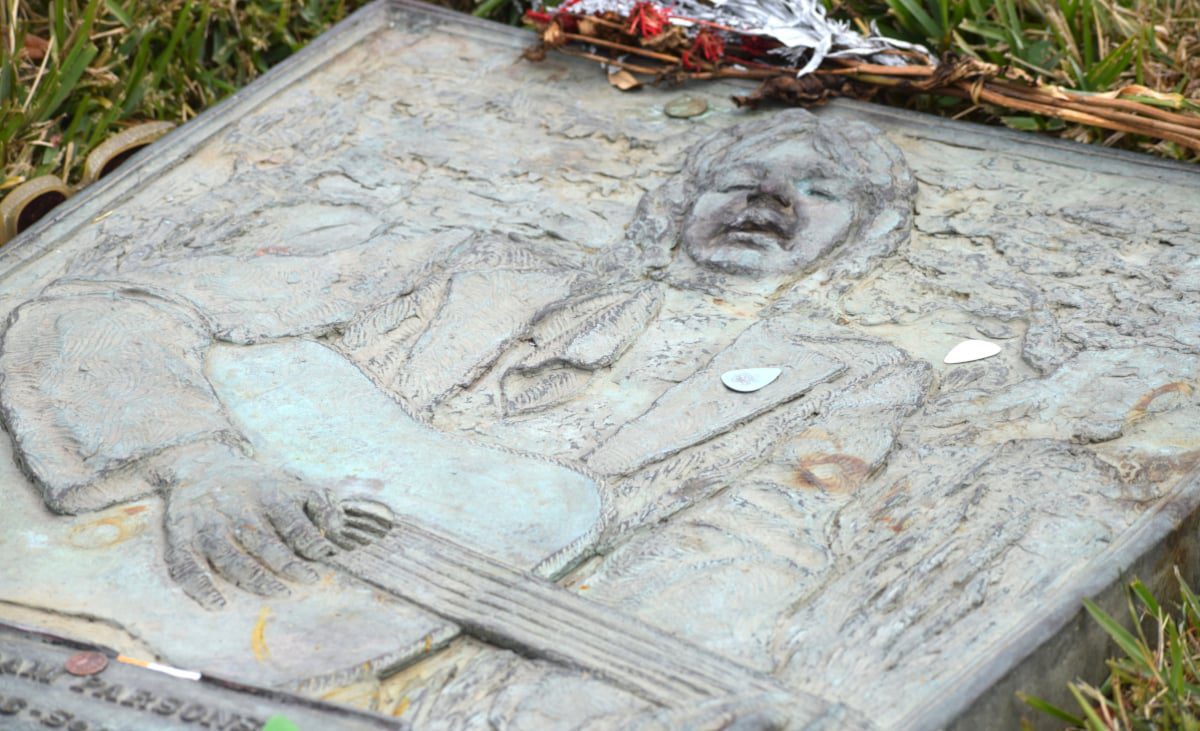
The grave of Gram Parsons might be out of the way, but it’s not unloved. Guitar picks, drum sticks, other mementos can be seen at the grave. There was even a Captain’s hat, likely an allusion to Gram’s first hit, “Luxury Liner” with his International Submarine Band. The headstone is beautifully inscripted and adorned with a depiction of Gram, but is also not gaudy like some headstones, and sits flush to the ground. However, the headstone is also in need of care, showing signs of weathering and maybe oxidation, likely aided by its proximity to salt water in New Orleans.
The grave of Gram Parsons is located at the Garden of Memories Cemetery at 4900 Airline Highway Metairie, Louisiana 70001. He is located in the central western part of the cemetery, Plot R, grave R-12-11-2. The easiest way to get to find the grave is to pull into the cemetery, turn right in front of the office/chapel, and park in the far southwest corner of the parking lot. From there you will find the inverted ‘V’ path that you can follow to Plot R. Look for the big tree near the back of the cemetery, as well as a white concrete bench and a blue water spigot. Gram is just to the right of these.
He’s someone whose music I have loved since high school. He’s still someone who is like a reference of if you like him we probably vibe. But I’m 37 now and gaining more perspective on just how young he was and how sad it is to die at 27
Great piece, Trigger. Although my father had a lot of old country albums (from Jimmie Rodgers to Hank to Johnny) I, like many who came of age in the late 60s and 70s eschewed that for rock and roll. Or worse. 🙂
In the early 90s I began looking for something that felt more authentic and found Uncle Tupelo and the Jayhawks right when they release Anodyne and Hollywood Town Hall, respectively. That soon to Son Volt and Wilco and on and on eventually getting me back to Sweetheart of the Rodeo and eventually Gram. So, for me at least, Gram became ground zero for this music that I loved along with the noise that was coming from Seattle. Every so often I run through the few songs he left us. As the great poet once said, it’s better to burn out than fade away.
Its unfortunate he didnt get the funeral he wanted or that greed got him buried in a place far from where he wanted or home.
How did greed play a part? Are you saying he wanted Joshua Tree? Was that well known beyond some late night convos he had while just shooting the shit?
I give him direct credit for the ’90s alt-country movement. Even though I didn’t come to Gram Parsons directly, his fingerprints are all over the music that did shape me. Artists like Whiskeytown/Ryan Adams, Uncle Tupelo and its offshoots (Wilco and Son Volt), The Jayhawks, and the Old 97’s carried forward the country-rock hybrid Parsons helped define. Without discovering those bands first, I likely never would have gone back and found Gram at all—which says a lot about how enduring and foundational his influence really is.
I came to GP through the same route, but, I started with Drive By Truckers as I was living in Alabama. Got to UT. Never saw UT – damn. But I sure did listen to them and say, what sorcery is this. And then onto Gram like you. Full circle, growing up in Hendersonville, next door neighbor was Ralph Emery’s granddaughter (she was same age as me) and family (Ralph’s son). Met Ralph a few times as a teenager. Only 30 years or so later did I learn he was the Drug Store Truck Drivin Man.
I don’t know Gram’s relationship with his step father/family. I don’t know what it was with Phil Kaufman either. With that said, it is my belief that funerals/resting places are for the living, not the one who died. I’ve said some shit while high, hanging out with my buddies, “Spread my ashes on the Seahawks field” or whatever, when it comes down to it though it should be the family that decides what happens with the body. My wife knows what I want, I believe it is even in writing in our will, but absent of that the family should choose. I know nothing of Phil Kaufman, but it always rubbed me the wrong way hearing how that happened. If Gram took his step father’s name, and kept it I assume they had a decent relationship. No matter how good of friends I was with someone I couldn’t imagine stealing their body against their family’s wishes. I’m curious how Emmylou feels about it.
Source: savingcountrymusic.com