
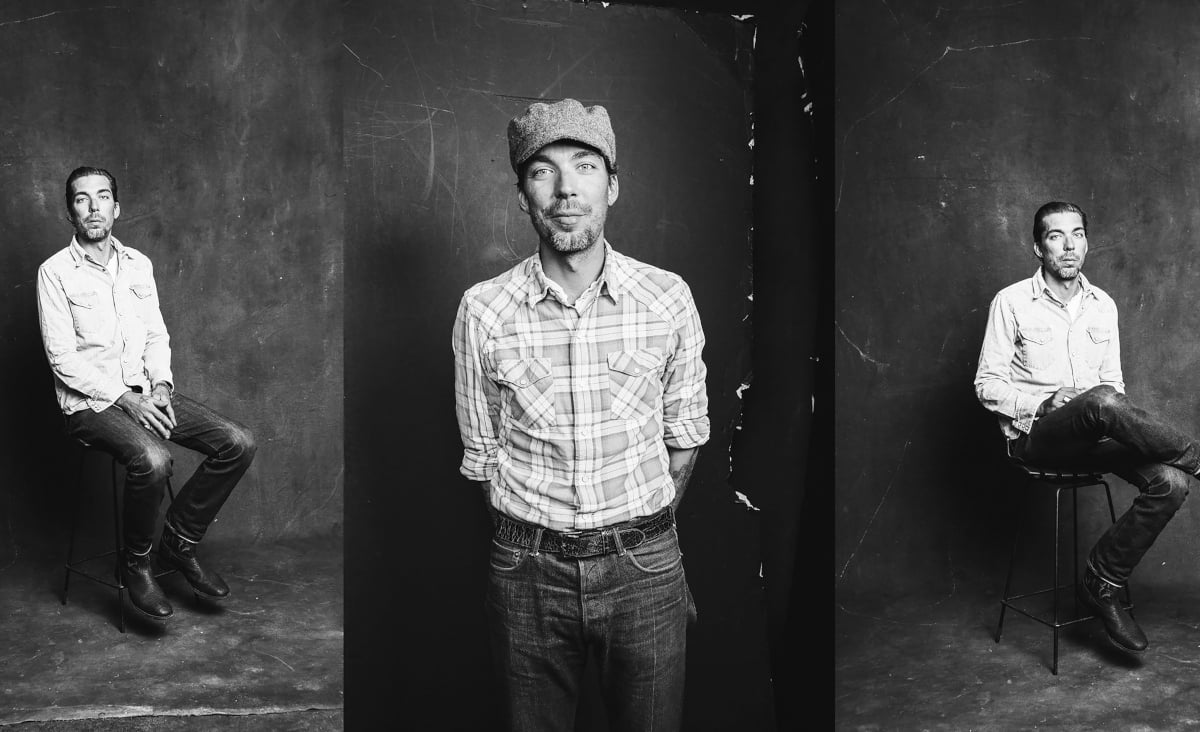
Don’t let the word “authorized” spook you into believing this account in any way sugar coats or omits the truth of things. On the contrary, the biography is a stark, harrowing, and sometimes difficult story to tell and read.
Justin decided after playing the Grand Ole Opry, which he felt was a huge achievement, that he didn’t want to be part of country music. Though he first emerged as a country traditionalist with his debut LPs The Good Life (2008) and Midnight At The Movies (2009), he felt the genre was too commercialized. This is why he started leaning more into blues and Gospel on subsequent albums. As author Jonathan Bernstein observes in Chapter 11 of the book, “Justin Townes Earl was defining himself through opposition and in contradictions. He was eager to entertain yet quick to disassociate with any genre that wanted to claim him. He was anxious to be taken more seriously as a songwriter while doubling down on a campy stage presence that could overshadow that talent. He was desperate for recognition yet quick to discount his own dreams—like playing the Opry—when he achieved them. He was hungry for stardom yet deeply resistant of anything that looked like a conventional path to success.”Through this early part of his career, Justin didn’t have a band, just mandolin player Cory Younts from the Chicken Shack gang. Younts was an Eagle Scout who also worked at the Philmont Scout Ranch in the summers. They toured in Earle’s F-150. Justin told Younts that his song “Poor Fool” was about him. When they were playing on the now legendary “Big Surprise Tour” headlined by Old Crow Medicine Show, Cory spent a lot of time hanging out on the Old Crow bus. Earle officially fired him to forgo the awkwardness of Cory having to ask him if it was okay to join Old Crow full-time. Ahead of the release of his album Harlem River Blues, Justin Townes Earle first moved to Brooklyn, then to Manhattan—specifically an apartment complex at 516 East 11st Street that was mythical in the annals of American music. Guitarist Eric Ambel who played for Steve Earle lived there for many years. And even though Justin continued to try and publicly distance from his father, he was moving where his father had moved with then wife Allison Moorer. This is also where and when Justin’s sobriety became more public facing, hiding a private lie. Jonathan Bernstein says, “There were long periods where it seemed like Justin found a managable state of mental and chemical equilibrium. And there were periods of genuine abstention from alcohol and drugs other than weed, periods when Justin’s reliance on chemicals was limited to prescribed medication. But the reality is that, after emerging from rehab in 2010, Justin spent the next decade in an unceasing struggle with his illness.” Chapter 15 covers the notorious incident at Radio Radio in Indianapolis where Justin Townes Earle was arrested, and accused of “hitting a woman with a closed fist,” even though as the book portrays, the specifics of the incident are still disputed. Joshua Hedley was playing fiddle with Justin, and Bryn Davis played bass. Justin was definitely using again at the time, trashed out the green room, and allegedly was confronted by the owner. When the owner’s daughter got in between the two, that is when she allegedly received an inadvertent belt. The characterization of Justin Townes Earle hitting a woman really hurt him, both publicly and personally. It became yet another burden for him to carry, and one he publicly disputed, even though the accusation would come up again later.
Though Justin attended rehab after the Indianapolis incident once again, his life never seemed to fully get back on track afterwards. When his album Single Mothers came out in 2014 and was commercially unsuccessful, Justin also starting to lose his live draw. When the rise of Sturgill Simpson, Chris Stapleton, and Jason Isbell was celebrated in a GQ photo/spread in early 2016, Justin was nowhere to be found, even though he very much helped spark the roots revolution these three took to the masses. Another keen observation author Jonathan Bernstein has about this time is, “The entire network and infrastructure of blogs and independent music media that supported and spread the word about artists like Justin Townes Earle in the late 2000s and early 2010s had all but dried up or vanished. Not coincidentally, those two years marked the rise of streaming services like Spotify.” The recurring theme throughout the book is the frosty relationship between Justin Townes Earle and his father. Though Justin made it part of his public persona that his father was never there, the elder Earle provided often for Justin, hired him via a publishing company he created so he could focus on writing songs, employed him in his band, allowed him to live at his house near Nashville for extended periods during his young adult life, and would have done more if Justin didn’t hold so much resentment. As the book observes, “There were moments earlier in Justin’s career when Justin would slag off on his dad in a phone interview, end the call, and then immediately ring his dad to say hello.”There is also the recurring theme of “the myth” as Jonathan Bernstein calls it that followed Justin Townes Earle like a ghost, not just from his father’s name, but from Townes Van Zandt and his tragic story, as well as the tragic stories of so many songwriters who felt like they had to suffer for their art and to sing from an honest, authentic perspective. For Justin, he had a triple whammy to contend with when it came to generational addiction issues, expectations from namesakes, and a toxic mythology.Meeting his wife Jenn Marie really helped just for a bit. They moved to tiny Westport, California on the coast, then to Portland, Oregon. Jenn Marie got pregnant. Justin started calling his dad even more. Chapter 22 might be one of the hardest of the book to read. Though Justin was clearly elated at becoming a father, it also clearly filled him with fear and anxiety. He booked a European tour right before the birth. When his daughter Etta came a month early, Earle was on stage. When he was notified, he chose to finish the final days of the tour out before returning home. Then on his way back home to Portland, there was a missing day where Earle vanished. Days went by after the birth that Justin wouldn’t call. He carried a lot of guilt for missing the birth, but didn’t seem to know how to make it right. After all, he’d named his 2015 album Absent Fathers—the ultimate rebuke of dad Steve. He did finally return to meet his daughter. A few months later though, Justin was on the road again. This is when Justin had another serious relapse.
As Jonathan Bernstein smartly and importantly observes, “Those employed by Justin were placed in a difficult position: say yes to the boss or get fired. It was a position many had found themselves in throughout the years. And many of those employed by Justin believed that once he was already off the wagon, he’d be better off surrounded by those for him rather than whomever they imagined he’d replace them with if they told him no. This, broadly speaking, was how the music industry worked: Artists toured to earn a living for themselves and to keep members of their team employed. If that artist, writing from the threat of withdrawal, needed cocaine, someone found them cocaine.” This leads to one of the worst episodes recounted in the book involving Justin and his wife Jenn Marie. “The couple started yelling. When Etta awoke at the commotion and began crying, Jenn Marie implored Justin not to go upstairs to see her. The couple got into a physical altercation on the staircase, at which point Justin, ‘swung his hand and phone back and struck Jennifer in the face,’ according to the report. Jenn Marie called 911. When police arrived, they photographed her injuries: a gash down the middle of her nose, cuts on her hand, and a bump above her left eye, which was bruised almost to the point of being swollen shut.” Justin was taken to jail, charged with fourth degree assault. The day before Etta’s first birthday, he flew to Austin for rehab.
In the beginning of the final chapter, it’s revealed that Justin was also arrested for public intoxication at the San Antonio airport, and also charged with possession of cocaine. When hometown hero Steve Earle bailed him out though, all charges were miraculously dropped. Eventually you get to the inevitable conclusion, which is the combination of the COVID-19 pandemic, the fentanyl scourge, and Justin’s own predilections resulting in his tragic death. At this point in the book, even author Jonathan Bernstein seems exhausted by all the drama, and all the attempts to rehabilitate Justin and resuscitate his career. Shortly before his death, Justin was in the hospital with pneumonia from aspirating into his lungs from drinking too much. He saw his wife and child who he’d been estranged from for a year around this time. They all said they loved each other, with Jenn and Etta returning to Montana, and Justin remaining in Nashville, waiting for the pandemic to lift to resume touring. “An autopsy report eventually determined the cause of death: an accidental overdose after ingesting cocaine laced with fentanyl,” Jonathan Bernstein writes mater-of-factly. “He had died on the evening of August 20, [2020] it was determined, in an apartment that was little more than a mile from the hospital in which he’d been born.” Justin Townes Earle left an inspiring catalog of songs and albums behind, but even that feels somewhat marred by how it all ended. This story was a tragedy, and at times, an incredibly ugly one. What Do You Do When You’re Lonesome starts off as a wickedly compelling, page-turning read. But at the end, you almost feel as empty and hopeless as Justin must have felt in his final days. Nonetheless, this is a story that feels like essential reading, because it’s a story that’s playing out as we speak in tour buses, hotel rooms, in lonely one bedroom apartments populated by the people we pay to have entertain us through music. They all seems unnaturally predisposed to addiction, mental health issues, and general malaise. It’s their broken nature that intrigues us. But that broken-ness should never be the entertainment itself. Solving the mental health and addiction issues while saving the music is one of the most complex, but imperative challenges the music community faces. Hopefully the life Justin Townes Earle lived, and the story Jonathan Bernstein tells goes a long way to doing this. The sacrifice and the effort sure feel worthy of it. 8.6/10 – – – – – – – – – – – –Purchase: What Do You Do When You’re Lonesome: The Authorized Biography of Justin Townes Earle
Allison Moore, Bonnie Whitmore, Bryn Davis, Cory Younts, Dustin Welch, Eric Ambel, Jonathan Bernstein, Joshua Black Wilkins, Joshua Hedley, Justin Townes Earle, Kurt Cobain, Leadbelly, Old Crow Medicine Show, Review, Steve Earle, The Swindlers, Townes Van Zandt, Travis Nicholson, Willie Domann
Thanks for the wonderful review and I’m excited to read the book. Justin will always be special to me. I dated a girl long distance in 2009. We would make each other mix cds and mail them to each other. At the time she wasn’t a fan of country music. But she sent me a mix cd that included Justin’s song “ain’t glad I’m leaving”. She wrote in her letter (where she reviewed each song included) this is as country as I get.
At the time I was blown away by the song and told her “this is as country as anyone gets.” Justin immediately became my favorite singer and opened up the world of independent country and is the reason I’m here reading this site. Justin is no longer my favorite but he’s always going to be special to me. Really grateful the music he was able to give us
Im definately going to read this , but it does sound harrowing and it also sounds like Jenni went through a heck of a lot of abuse herself and in front of his own daughter . So im sorry but the lines of a Jason Isbell song are the tip of the iceberg really. Justin’s music stands tall but sadly he wad the saint of lost causes. Its just so sad that the love of a woman and motherhood couldnt even inspire him to get his shit together.
I saw Justin open up for Dan Auerbach in Columbus, OH.
Just Justin and a guitar, on Halfway to Jackson it sounded like 3 guitars were on stage.
Very talented guy.
Source: savingcountrymusic.com